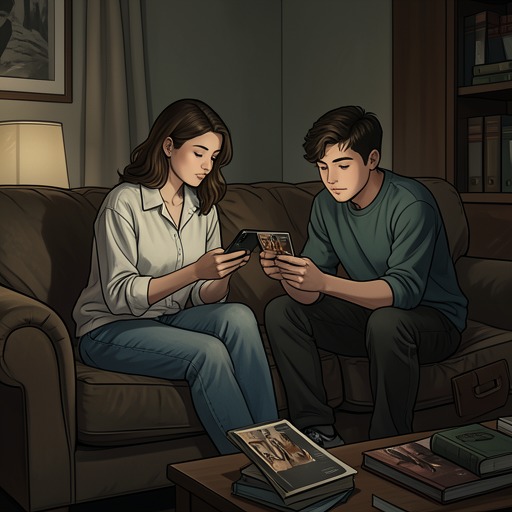
Hannah reveals Owen’s fabricated identity to Bailey
The Last Thing He Told MeHannah Hall’s revelation to Bailey Michaels that Owen Michaels may have built his life around a false identity changes their search for him into a confrontation with what that deception means for both of them. The information is incomplete and secondhand, but its implications are intimate: Bailey may not know the original name or personal history her father gave her, while Hannah must face that Owen lied to her as well. By the end of the conversation, they do not have answers or a guarantee that the deception can be forgiven; they have a shared decision to keep looking for Owen and to face what they find together.
The Disclosure and Its Limits
The conversation takes place over coffee and gingerbread pancakes in an all-night diner in South Austin. Bailey enjoys the sweet pancakes, and watching her eat gives Hannah a small sense that she is doing something good for her. Yet the ordinary meal cannot make the news easier to deliver. They sit near the door beneath a flashing red sign reading “SORRY WE’RE OPEN,” while Hannah tries to find the words. The contrast between breakfast and revelation gives the scene its sharpness: Hannah is caring for Bailey in a familiar, practical way at the very moment she is about to unsettle the story Bailey has been told about her family.
Hannah begins by saying that Bailey’s father has not always used the name Owen Michaels. She explains that his life story may have been changed too. The account Bailey had heard—that he grew up in Massachusetts, graduated from Princeton University, and moved to Seattle at twenty-two—is not supported by what Hannah has learned. She carefully preserves the distinction between an established fact and an unverified biography: they cannot prove that Owen did those things as he described them. The revelation is therefore not a complete reconstruction of his past. It is evidence that the version he presented cannot be relied on, and a warning that the truth remains unknown.
Hannah identifies the source without pretending to know more than she does. A friend in New York works with an investigator who focuses on this kind of question; that investigator believes Owen changed his identity shortly before the move to Sausalito and is sure that a change occurred. This chain of reporting gives Hannah grounds to tell Bailey, but not a full explanation of why Owen did it or what name he used before. Hannah offers a possibility—that he was trying to keep Bailey safe—only as her guess. She does not claim to know what danger he feared or whether his actions were justified.
Bailey’s Identity and Anger
Bailey first asks who told Hannah, then asks why her father would have done this. The question shifts the disclosure from Owen’s biography to its possible motive. Hannah proposes protection, but Bailey recalls her father’s own principle: people running from something are often running from themselves. Her response keeps the possibility of self-preservation in view alongside Hannah’s more generous explanation. Neither woman can settle the question from the information available to them.
The most personal consequence emerges when Bailey reasons that, if Owen changed his identity, he may have changed hers too. She asks whether her name and everything about her were altered at some point, including her birthday. Hannah confirms the possibility conditionally: if the investigator is correct, Bailey once went by another name. The exchange makes clear that the concealment may reach beyond a father’s chosen biography and into the details by which Bailey understands herself. The evidence does not establish what her former name was or whether her birthday was changed; Bailey’s question marks the uncertainty rather than resolving it.
Bailey states what she can know: Owen lied to her. Hannah sees anger rising in her and recognizes it as justified. Even if Owen acted for Bailey’s benefit, and even if he believed he had no choice, the decision excluded Bailey from basic facts about her own life. Hannah does not use the possibility of protection to dismiss that injury. Forgiveness remains an open question for both of them, not a conclusion Hannah can impose on Bailey. When Hannah adds that Owen lied to her too, she places herself inside the breach of trust rather than presenting herself as an untouched guide through it.
From Disclosure to a Shared Decision
The revelation also changes Hannah’s understanding of how to be there for Bailey. Hannah recognizes that she had been relying on niceness and sweetness to show that Bailey could count on her. She now understands that reliability is tested when neither person has the energy to be pleasant or to try hard. Her response is not another explanation of Owen’s motives, but a commitment to do what is necessary for Bailey to feel safe, an obligation she connects to what her grandfather did for her. The discovery of the lie thus produces a practical change in Hannah’s role: she must demonstrate care through what she does, not expect Bailey to infer it from good intentions.
Bailey asks what they should do now. Her laughter has given way quickly to tears, but she finds her center and asks the question in terms of “we.” Hannah takes that pronoun as a sign that, despite the anger and uncertainty, Bailey is treating the two of them as a unit in the immediate crisis. They are far from home, in a place neither wanted to reach, and Hannah wishes Bailey did not have to be there. Still, both want to continue the search for Owen, wherever he is and whatever he has hidden. Hannah answers that they will fix it. The decision does not erase the breach or promise a quick repair; it establishes a shared purpose in the face of what they do not yet know.
Immediate Aftermath
The next morning, Hannah prepares to call him only after she feels calm enough to do what she needs to do. She gathers her notes, dresses, and leaves the hotel room quietly so as not to wake Bailey. Rather than make the call in the room, she goes outside, where she can better control what he hears in the background. The careful preparations carry the scene’s change in responsibility into action: Hannah is no longer simply passing information to Bailey but preparing to pursue Owen with the new knowledge in hand. The revelation leaves the central questions unanswered, yet it has altered their search. They are looking not only for Owen, but for the truth behind the identity and family history he gave them.